Open source, MIT licensed, self-hosted
Find the stage where your RAG breaks, and prove the fix before you ship.
RAGOps Observatory follows every answer through retrieval, ranking and generation. It names the stage that failed and what to change, blocks a version that is worse than the live one, and signs a Ready or Not ready report you can hand to a client.
- Query14 ms
- Retrievetop 20, 52 ms
- Reranktop 3, 31 ms
- Prompt3 chunks
- Generate1.9 s
Following the request through each stage…
An illustration of what the dashboard shows for one request.
Six questions it answers, on one screen each
Tracing tools show what happened. RAGOps tells you which part broke, whether the next version is safer, and whether you can sign it off. Pick a question.
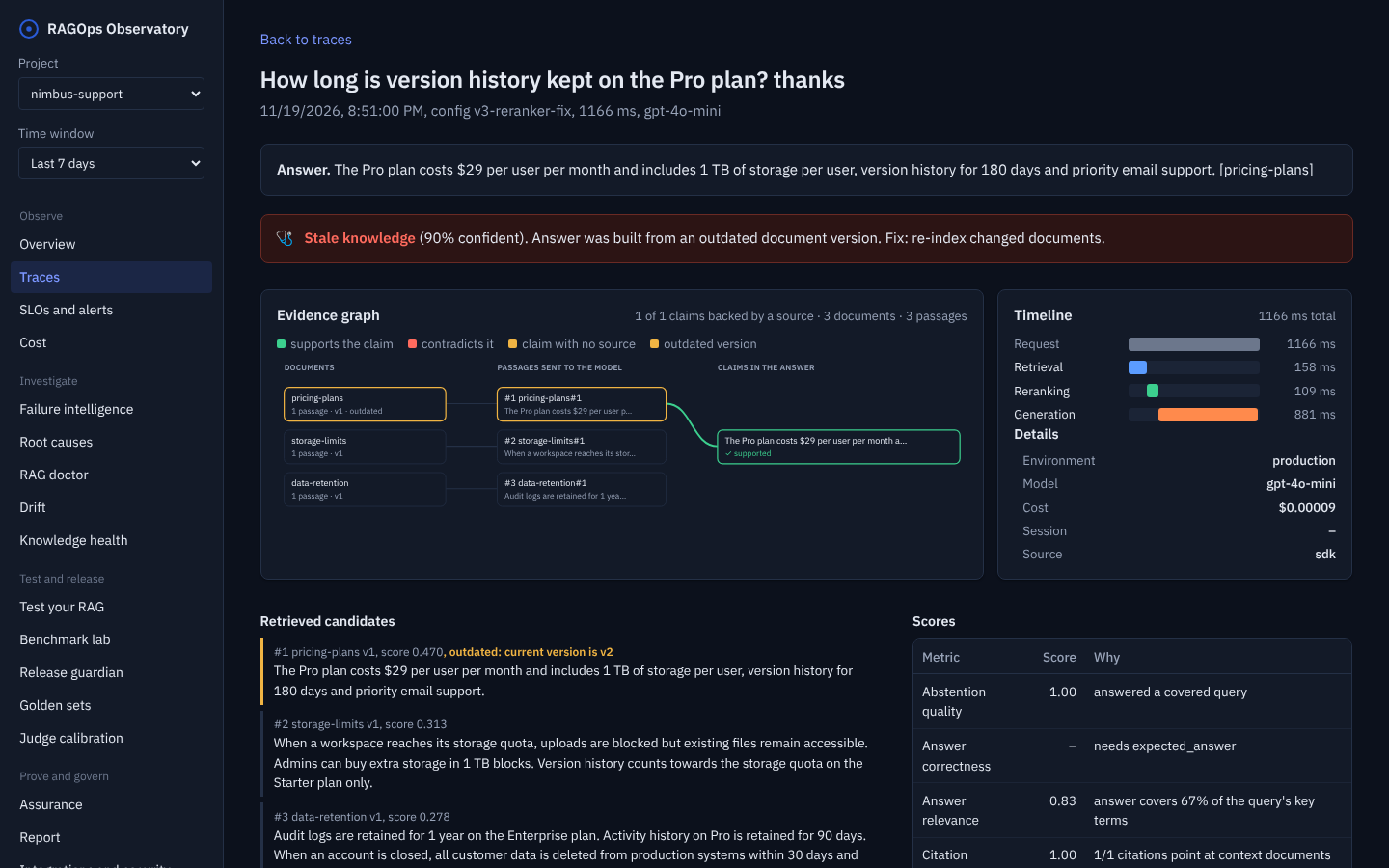
A score is not a fix. This closes the loop.
A wrong answer can come from the documents, the search, the ranking, the prompt or the model. Each step is a dashboard page, an API call and a CLI command.
- TraceEvery request and its steps, from the Python or TypeScript SDK, or OpenTelemetry.
- ScoreCorrectness, faithfulness, relevance and ranking, with a free judge or any LLM.
- DiagnoseThe failing stage for each bad answer, the evidence and a fix.
- GroupSimilar failures become one pattern instead of a hundred traces.
- TestQuestions from your own documents, with refusals and injection probes.
- GateThe candidate against the live version: Pass, Review or Block.
- CertifyA Ready or Not ready report with a fingerprint anyone can check.
It said Not ready twice. Both times the measurement was wrong.
A real help-centre assistant on Sarvam 105B. The first test set came from the wrong folder, and two scoring rules marked reworded answers wrong; the diagnosis pointed at both. Then the release guardian blocked one version and passed the next.
v2 to v1, smaller top_k. Pass rate fell from 95% to 90% on 21 questions.
v1 to v3, fixed prompt. 90% to 100%, nothing newly failing, slowest answers 6.0 s to 3.8 s.
279 real questions afterwards. 95.3% correct; most of the rest asked about things no document covers, which the drift page listed as new topics.
Works with the tools you already use
RAGOps is not a replacement for a tracing platform or an evaluation library. It imports traces from Langfuse and Arize Phoenix, takes OpenTelemetry spans, and can use Ragas as its judge.
| The question you have | Tracing platforms | Evaluation libraries | RAGOps |
|---|---|---|---|
| What happened in this request? | Yes | No | Yes |
| How good are the answers? | Some | Yes | Yes |
| Which stage failed, and what should change? | No | No | Yes |
| Is the new version safe to release? | No | No | Yes |
| Can I prove it to a client? | No | No | Yes |
Choose a larger platform such as Langfuse, LangSmith or Arize Phoenix if you need tracing for many kinds of LLM apps, or a hosted service. Tools change quickly; check their current documentation.
- LangChain
- LlamaIndex
- Haystack
- LangGraph
- OpenTelemetry
- Langfuse import
- Phoenix import
- Ragas
- Evidently
- Presidio
- OpenAI-compatible models
- Ollama
- PostgreSQL + pgvector
- Redis
- ClickHouse
- Docker
- Helm
- GitHub Actions
- Python SDK
- TypeScript SDK
Run it yourself in two minutes
Python 3.11 or newer. The demo needs no API key: it loads 14 days of realistic traffic with failures to investigate and a release to judge.
pip install "ragops-observatory[server,dashboard]"
ragops demo
ragops serve
# open http://localhost:8000/ui   key: ragops-admin-dev-key
ragops init                # ragops.yaml, my_rag.py, rag_tests.jsonl
ragops generate docs/ --n 30 --out tests.jsonl --security
ragops test --json-out run.json
ragops assure --from-json run.json
ragops gate --pipeline my_rag.py:pipeline \
  --baseline prod.yaml --candidate new.yaml \
  --golden tests.jsonl --out gate.md
# exit code 0 = pass, 1 = blocked
- Your pipeline is any Python function that takes a question and returns an answer and its sources. LangChain, LlamaIndex, Haystack and LangGraph examples are included.
- The judge is free and rule-based by default. Set
RAGOPS_JUDGE=openaifor any OpenAI-compatible model, or use Ollama. - For a team: Docker Compose and a Helm chart, PostgreSQL with pgvector, Redis, ClickHouse, OIDC sign-in, roles and an audit log.
- Windows works. Only the optional ClickHouse engine is skipped.
Before you trust a number
- The free judge is reproducible but misjudges reworded answers. Use an LLM judge for real scoring, and check it with
ragops judge check. - LLM answers vary between runs. Run each version more than once, and use 50 or more questions before trusting small differences.
- Generated questions are a first draft; read them before relying on them.
- The assurance report is evidence, not a certificate of compliance.
Help build it
- Found a wrong diagnosis? Open an issue with the question, the answer and the stage you expected.
- Next on the roadmap: larger benchmarks, multi-turn and agent traces, test generation in Indian languages, and a hosted version.
- Using it in a report or paper? Cite it with CITATION.cff.