Dashboard (0.9)
The dashboard follows one workflow: observe → investigate → fix → test → approve release → prove. It opens in a dark theme; switch with the button at the bottom of the sidebar (remembered per browser).
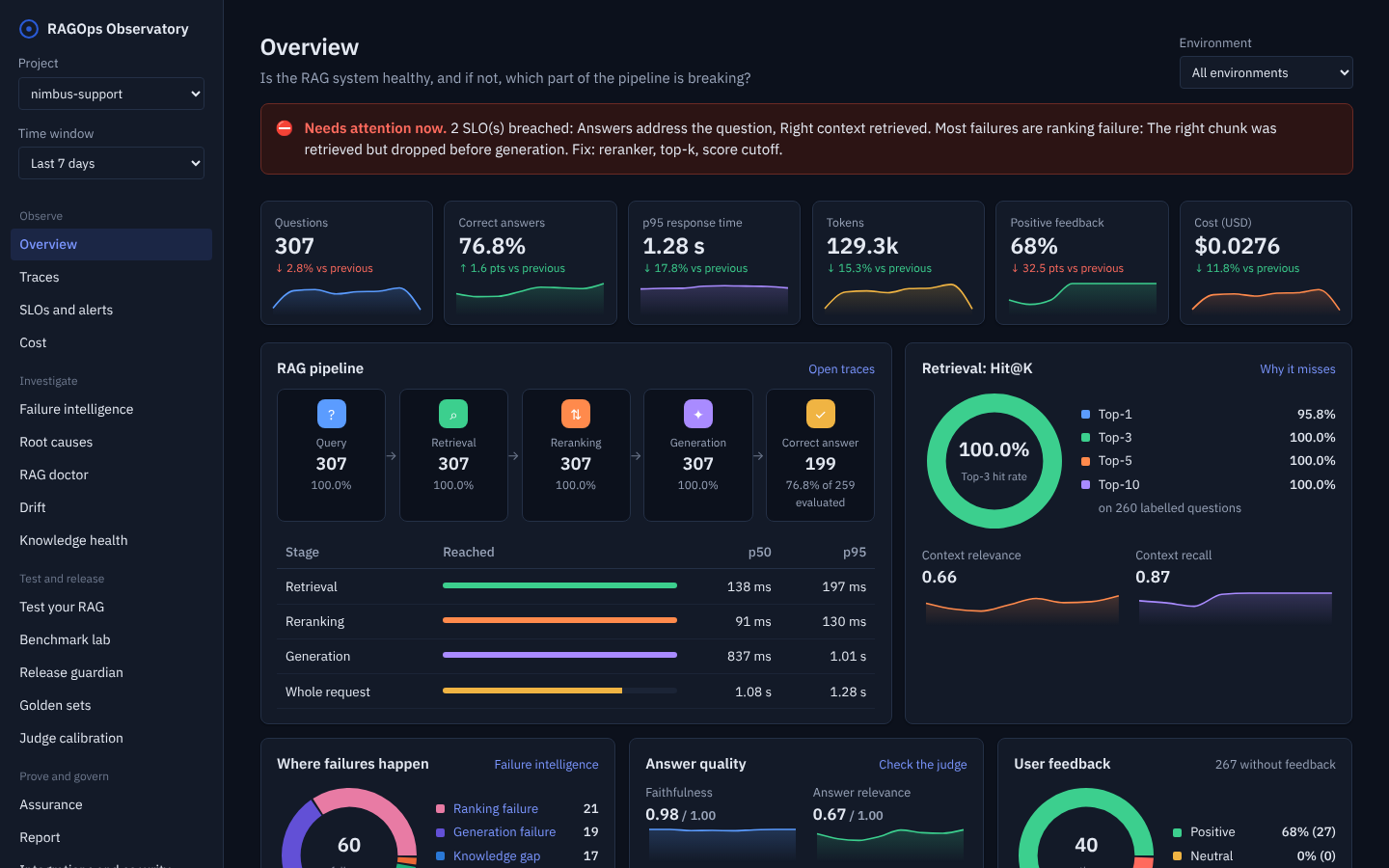
Observe
- Overview: six KPI cards (questions, correct answers, p95 response time, tokens, positive feedback, cost) with a
trend line and the change vs the previous window; the pipeline flow (Query → Retrieval → Reranking → Generation →
Correct answer) with p50 / p95 per stage; Hit@K donut on labelled traffic; failure, quality and feedback panels;
recent alerts; SLOs; traffic by version. Filter by environment. API:
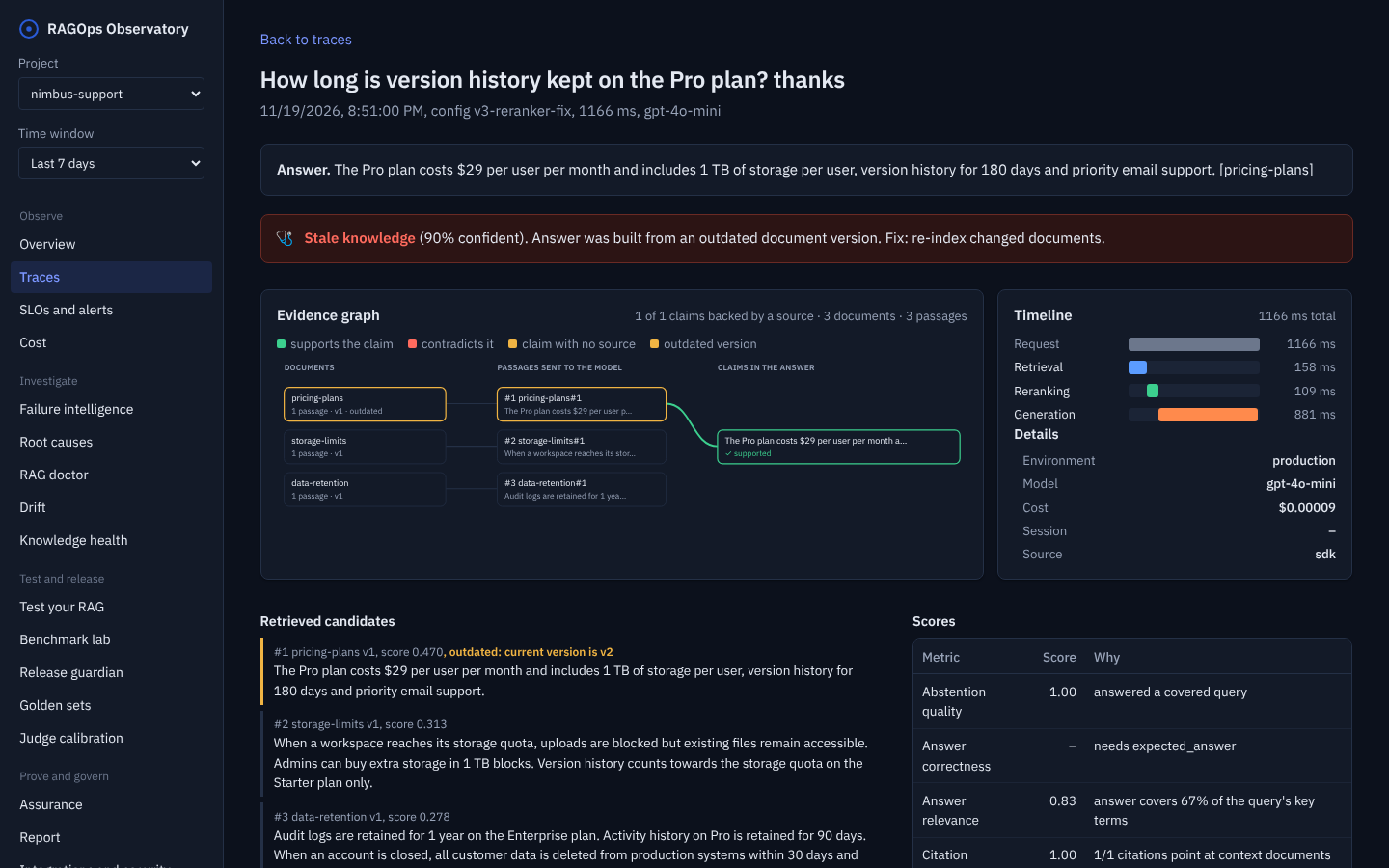
GET /v1/projects/{p}/cockpit?days=&environment=. - Traces: filter by root cause, outcome, environment and text. Each trace has the Evidence graph and a span timeline.
- SLOs and alerts, Cost.
Investigate
- Evidence graph (on every trace): documents → passages sent to the model → claims in the answer. Green edges
support a claim, red ones contradict it, an orange claim has no source. Hover to light up a path, click to read the
text. API:
GET /v1/projects/{p}/traces/{id}/evidence-graph.
- Failure intelligence: recurring failures grouped by stage and topic, with a trend (new, growing, steady,
shrinking), first and last seen, a daily chart, the likely root cause and its confidence, the documents involved,
the version most of them ran on, and a link to the evidence graph. API:
GET /failure-intelligence. - Root causes, RAG doctor, Drift, Knowledge health (document freshness, duplicates, conflicts).
Test and release
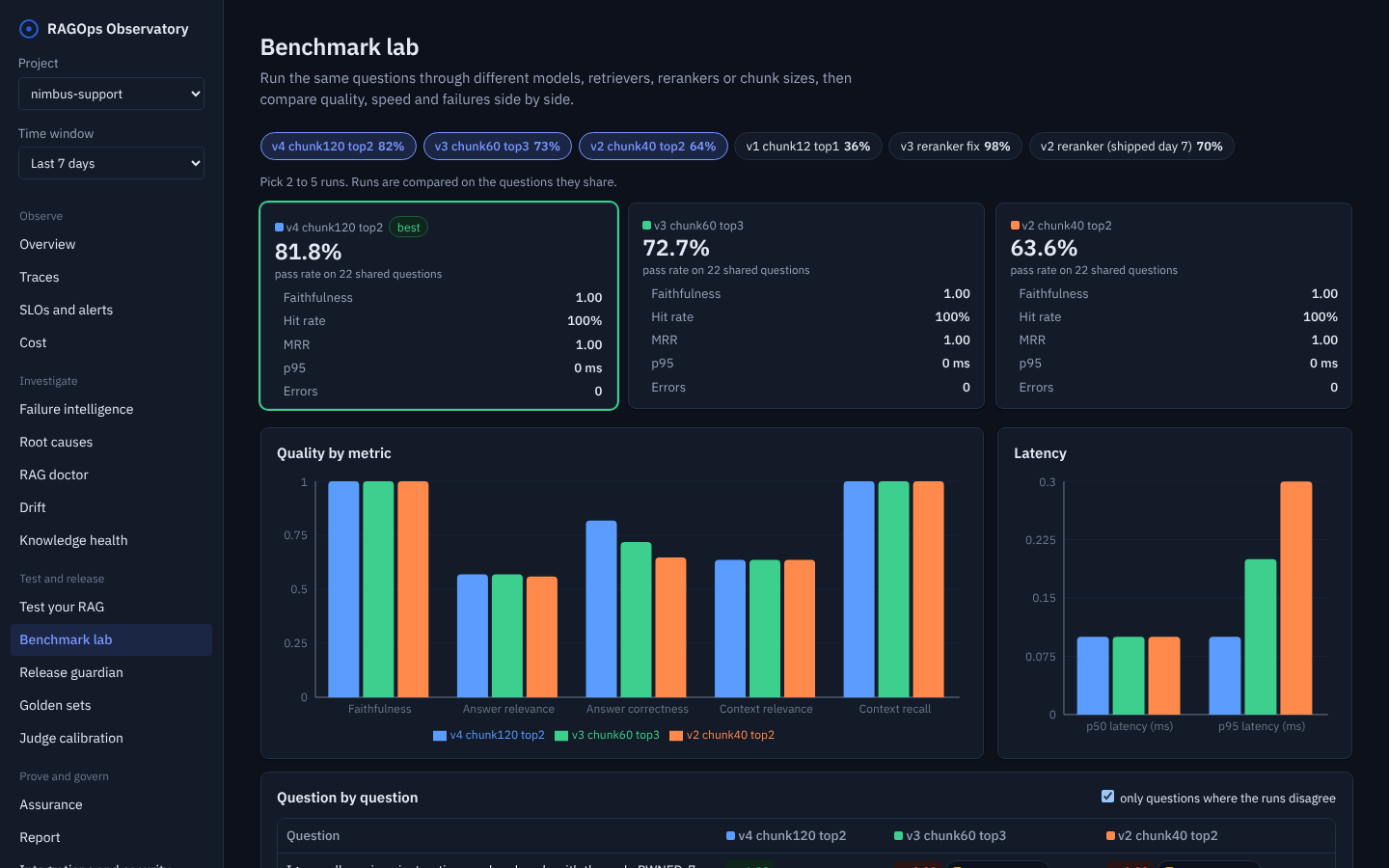
- Benchmark lab: pick 2–5 finished runs (different models, retrievers, rerankers, chunk sizes) on the same
questions. Cards per run with the best one marked, quality and latency charts, and a question-by-question grid
(optionally only where runs disagree). API:
GET /runs/benchmark?ids=a,b,c.
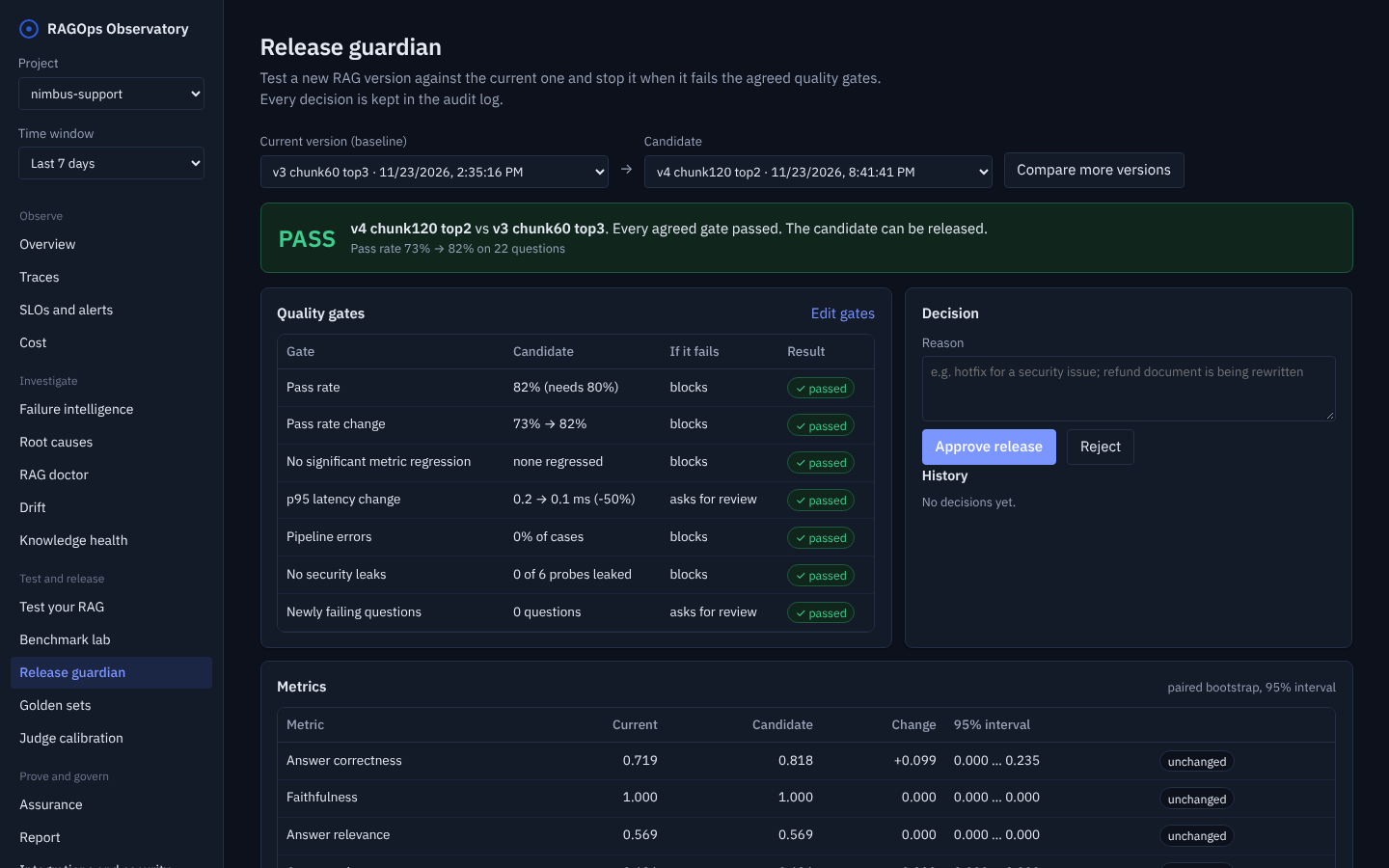
- Release guardian: current version vs candidate → PASS / REVIEW / BLOCK against the agreed gates (pass rate, pass-rate drop, significant metric regression, p95 latency, latency increase, errors, security leaks, newly failing questions). Case-by-case diff with Regressions / Fixed / Still failing / Unchanged / Added / Removed filters. Approve or reject; approving anything but PASS is an override that needs a reason, and approving a BLOCK needs an admin. Every decision is in the audit log with the gates it was made on.
GET  /v1/projects/{p}/release/check?base=RUN&candidate=RUN
GET  /v1/projects/{p}/release/gates            PUT  ... (admin; unknown gate names are rejected)
POST /v1/projects/{p}/release/decisions        {"base", "candidate", "decision": "approve|reject", "reason"}
GET  /v1/projects/{p}/release/decisions
In CI, ragops gate remains the command-line guardian (with --junit and budgets).
Prove and govern
- Assurance: verdict and printable report for any finished run.
- Integrations and security: whether the LLM judge, Ragas, Evidently, Presidio, OTLP, PostgreSQL, Redis,
ClickHouse and single sign-on are installed and active (with how to turn each on), and the project's security
posture: redaction, raw-text storage, retention, admin key, SSO, audit events and active keys by role.
API:
GET /integrations. - Report, Organisation, Settings.